
This post was originally published on hook, line & clincher - a blog on online marketing campaigns by Indian marketers.
How Uber builds its brand without spending heavily on mass media
Uber has been an inspirational brand since the moment it first stepped its foot in India. It already had attached to its name then, a $41bn valuation and one of world’s hottest start-ups tags. A few informed early adopters knew Uber for the name it was globally.
A wise person once said,
“Sex is in the product, not marketing”.
Get your product right and it will sell itself. There is a reason why we have never seen any mass media, traditional ads of the biggest companies that are known to us like Facebook, Twitter, Airbnb, Instagram and others that concentrated on communities, engagement and customer retention. All of them essentially followed a practice, now popularly called” Growth Hacking” which means acquiring more and more engaged users without using traditional marketing techniques.
To know more about “Growth Hacking”, click here
Uber’s marketing strategy in India was never once about large media spends or traditional mass marketing methods like TV, Print & OOH. It was never even about huge digital spends. Uber stuck to basics, always. The Uber team focused on building a good product, putting it out in the market and speaking about it in a language that instantly built a connect with the consumers. The idea was to convince the consumer to try out the product once and Uber was confident that the consumers would come back again.
This strategy, I assume, has more or less helped Uber in building a rider base even when all 3 of its major competitors – Ola, Taxi4Sure and Meru had TV campaigns and billboards all over.
Read: Hashtags used by Ola and Taxi4Sure to promote their services
Uber had a very thought out flow to their marketing approach
Launch -> Build Up -> Amplification -> Sustenance -> Growth
There were dedicated marketing activities initiated to achieve goals of the above phases.
PHASE 1 : LAUNCH
Influencer Marketing & Limited Access
Uber launched itself in Delhi NCR, Bangalore & Mumbai. They brought out a campaign called Rider Zero where they roped in key influencers from every city to try out Uber’s service for the first time “secretly”.
From Delhi, it was Zaheer Khan, Ranvijay, Neha Dhupia & NDTV Host Rajiv Makhni
From Mumbai, it was Anil Kapoor, Arbaaz Khan and Rahul Bose
From Bangalore, it was Raghu Dixit and Vasundhara Das

The idea was to reach out to millions of followers each of these celebrities has on Twitter to create a significant buzz around the Uber cab service.
PHASE 2 : BUILD UP
Referral Marketing
Well, the discussions in the meeting would have been around “How do we go viral?”. Instead of spending crores of marketing money on pushing traditional campaigns, Uber decided to spend the money on giving the consumers a first hand experience of the service to try out their product. Nothing works better for the Indian consumer than a discount on a service they need. Uber went heavy on referrals and the first thought was to target corporates asking them to become “Office Heroes”. Since then Uber’s referral marketing has evolved coupled with heavy discounts and free rides.

For every colleague you refer, Uber promised credits worth Rs.600 and Rs.10,000 who referred the most
PHASE 3 : AMPLIFICATION
Heavy Discounts, Festival Marketing & Product Development

With their referral marketing in full flow, Uber decided to go full throttle and amplify their launch with product development by launching new cars, building their coverage, expanding in other cities and the gift of choice from a hatchback to a sedan to luxury and finally even an auto rickshaw.
They decided to become ‘available’ for consumers when most needed which meant,
Uber delivered kites on Makar Sakranti, colors on Holi and cupcakes on Rakhi.Uber even offered discounted rides to your IPL matches and other key events.Uber also offered to give mums a Mother’s day makeover or lovers a ride in an Uber Chopper on Valentines Day.
 Now, festival marketing is not new at all,but for a new entrant global cab service company to appeal to consumers in the local context makes for a brilliant strategic move. The trick lies in being able to do this subtly, something that most brands fail at.

PHASE 4 : SUSTENANCE
Strategic partnerships
After all the right hooks and levers were pulled and things were moving north, you need to keep doing a little something to stay there. Now this was the key and the most impressive part of Uber’s strategy. The partnerships with other popular products and services that Uber cracked were not only intelligent but also path breaking in the start-up ecosystem.
Have a look at some of the really cool strategic partnerships that Uber cracked which helped its course
Tie up with Zomato
The option of booking an Uber from theZomato app to reach one’s favorite restaurant. Contextual and brilliant integration.


Tie up with Paytm
After they ran in trouble with the RBI regulatory authorities for flouting the 2 step verification rule for credit and debit card payments as well as using an US payment gateway – they had to integrate their payment system through PayTM wallet which in retrospect turned out to be a good move considering PayTM is now boasting of 10 million downloads on Google Playstore alone.

Tie up with BookMyShow
Uber tied up with BookMyShow as official logistics partner during the ongoing T20 Cricket season. Again, this proved to be extremely contextual.

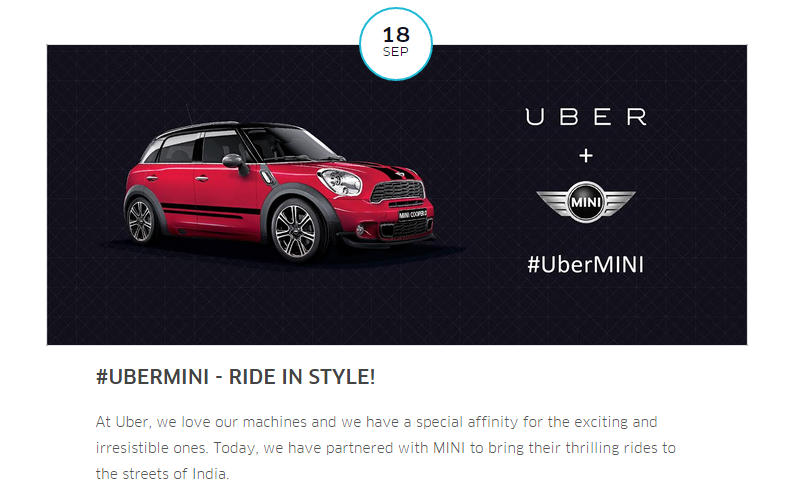
Tie up with Mini Cooper
Uber partnered with Mini Cooper to give their users a 15 minute ride using their app, completely free. Got you interested, want to download the Uber App just for this? Then use the code UberMINI14 to get Rs. 500 off on your first ride. Brilliant hook, yet another superb tie-up.

These are just a few examples which we found interesting. For more visit their blog.
PHASE 5 : GROWTH
For Growth, you need to keep doing things right consistently because memories are fragile and brands are replaceable.
Here are a few things that Uber is doing well to keep up its growth chart and make further inroads into the 48,000 crore taxi market in India.
Uber is being local
Uber is trying to catch the pulse and characteristics of every city. In my last post I stressed on how brands need to be more human for the consumers to connect. Uber is doing just that by catering to consumers city wise, respecting the diversity that exists even between consumers in India.

When I say Uber is being local I mean
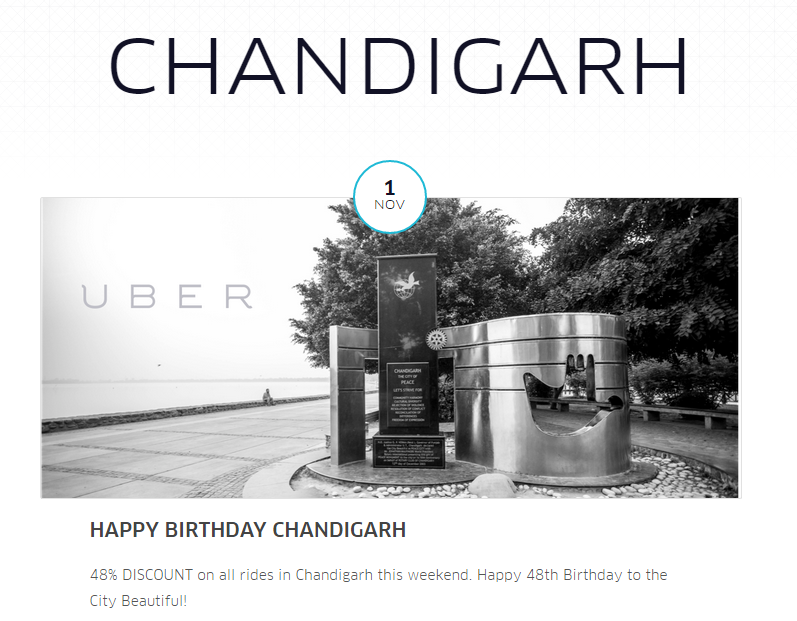
Uber gives discounts for everyone travelling to the Mumbai Business WeekThey give luxury cars for free for everyone attending the Vibrant Gujarat Summit in AhmedabadThey announce free pick up and drop service to the Chinnaswamy Stadium in BangaloreThey celebrate Chandigarh’s 48th Birthday and give a 48% discount on the sameThey celebrate Indian festivals by delivering kites, gujjiyas, colors and dhol on request

Uber is being safe and social
Uber did receive a major setback and backlash after the Delhi incident but they have tried very hard to come right back. Ample communication has been sent out telling people that Uber is completely safe now including issuing multiple apology letters for their debacle.

Uber is being social like every other brand now. They realize it is important to feel for issues that affect the consumers and be by their side in times of distress. They realize that standing up for a noble cause is perhaps just as important as providing good discounts.


FINAL WORDS
What do we know? What have we learnt?
In all of this, we have not seen Uber using any mass marketing methods like TV, Print, OOH or Radio. Forget ATL, not even any promoted post and tweets on Facebook & Twitter.Their primary means of communication with the consumer still remains SMS and Email which seem to be working fine for the time being.Uber has invested a lot on their blog to document their effortsThey are truly moving from 4Ps of Marketing to 3Cs.
Consistent, Contextual and Capability.
*All images have been sourced from Uber’s official blog
This post was originally published on hook, line & clincher - a blog on online marketing campaigns by Indian marketers.


No comments:
Post a Comment